

The pilot is done. Now remove the rest of the maze gates.
On June 24, 2026 the Township removed the maze gates (baffle gates) on the Parry Evans Trail and in the Richard Bulpitt neighbourhood, a pilot that Council funded after our campaign with HUB Cycling Langley. It was a real win, but it covered about 25 locations out of the 362 that staff say could be retrofitted. We are asking Council to fund a plan to remove the rest.
Where things stand
Staff estimated a retrofit costs $2,000 per location to remove one of the two baffles, or $5,500 to replace both with a single bollard. At those rates the remaining optional gates would cost roughly $0.7M to $1.9M, spread over a few budget years. That is about 0.4% to 1.2% of the $154.7M Smith Athletic Park.
Source: Township Engineering memo, Reducing Barriers to Urban Trail Users, October 31, 2025. Pilot count of about 25 locations per the November 3, 2025 Council discussion. Remaining-cost range is our calculation from staff's per-location estimates.
June 24, 2026: the gates come out
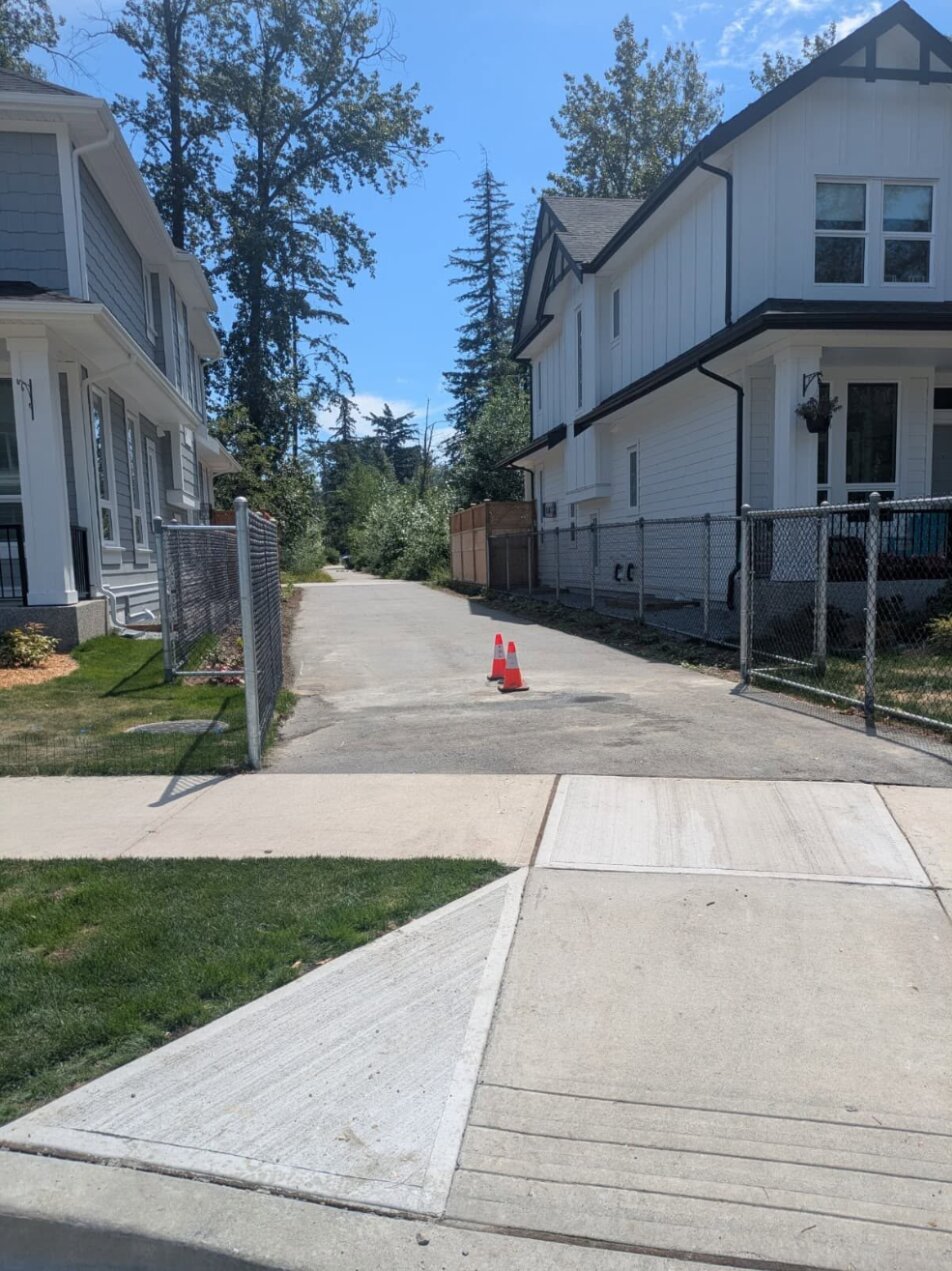
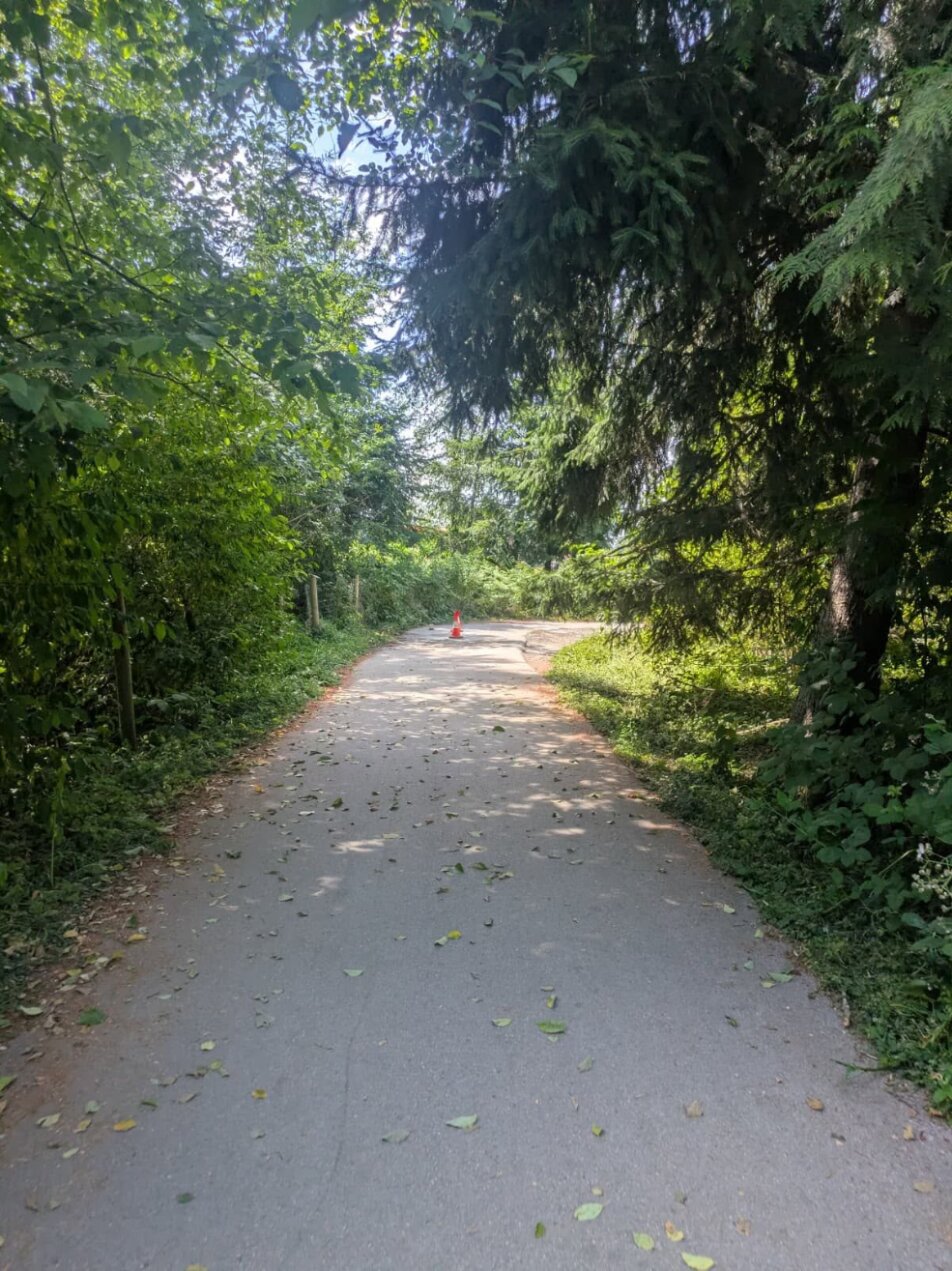
Thank you to Township Council for funding the pilot, to Township Engineering for delivering it, and to HUB Cycling Langley, who have pushed for this since 2018.
What our trail counter shows so far
With donations from our supporters we installed a Telraam counter overlooking the Parry Evans Trail between 208 and 209 Street. It began counting on May 5, giving us seven weeks of data before the gates came out. We publish what it shows, including when it does not tell the story we hoped for.
Cycling rose about 28% and walking about 16% in the two weeks right after the gates came out. That bump faded within a month, and the four weeks either side show no clear change. Trail use was already falling through May and June while the gates were still in place, and it fell further over the summer and into the school year. Season, weather, the school calendar and daylight move these numbers far more than one pilot can.
The fair test is next spring. We will compare May and June 2027 with May and June 2026, when the gates were still in. If you live along a trail and can host a second counter, let us know.
Method and caveats
- Data comes from the public telraam.net feed for segment 9000011148, in local time, using only hours the camera was running (3,795 of 3,805 hours). Car and truck counts on the trail are ignored.
- Telraam only classifies road users in daylight, so shorter fall days reduce counts. Comparing only 8am to 6pm, which is daylight for the whole study, shows the same pattern.
- School weekdays this fall averaged about 51 pedestrians a day, compared with about 109 on school weekdays in May and June.
- Cyclist counts dropped to 2 to 6 a day by October, a sharper drop than the season alone explains. We are checking the camera view for leaf growth or glare and will do a manual count to validate it.
- The busiest hour for walking stayed at 10am in every period.
- The counter sees one short stretch of trail. Most trips cross several gates, and most of the network still has them, so one segment cannot show the full benefit of a connected, gate-free network.
Download the data summary (JSON) or see live counts on telraam.net.
Why one trail is not enough
A trail network is only as accessible as its least accessible entrance. A parent with a bike trailer or a person using a mobility scooter can now get through the pilot area, but most trips end at a school, a park or another trail that still has a gate. Maze gates exclude:
- Parents with bike trailers, cargo bikes or double strollers
- People using wheelchairs, scooters and other mobility devices
- Adaptive cyclists on hand cycles and trikes
- Tandem bikes and wider e-bikes
- Seniors with walkers
- Anyone who has to dismount and squeeze through
Other cities have already done this. Coquitlam took maze gates out of its design standards in 2023 and has been removing them in phases. Township staff found that 9 of 17 Lower Mainland municipalities surveyed are removing or have removed most of theirs, and the 2019 BC Active Transportation Design Guide recommends against rigid barriers unless there is a history of vehicles entering the trail.
Map: pilot locations and gates still out there
Volunteer map compiled by Gaith Sarhan, HUB Cycling Langley and other contributors. Some mapped gates fall inside the pilot area and are now gone. Download the KML. See a gate we missed? Tell us.
What we are asking for now
1. Bring back the retrofit plan Council asked for
In November 2025 Council directed staff to report on a plan for the remaining gates, informed by the pilot. That report should come forward early in the new Council term, with the pilot's actual cost per location.
2. Fund it as a multi-year program
Roughly $0.7M to $1.9M would clear every optional gate. Spread over three or four budgets, that is a modest annual line item with a visible result in every neighbourhood.
3. Start with schools, parks and recreation facilities
Prioritize the gates kids and families pass every day, as staff already proposed, with input from HUB Cycling Langley and residents.
4. Finish the bylaw update so no new maze gates go in
Council directed staff to stop using the TLR 21 baffle design at new locations while the Subdivision and Development Servicing Bylaw is updated. That update should make the change permanent.
5. Publish the inventory and measure the results
Release the 447-gate inventory as open data and count trail use before and after future retrofits, so the next round of decisions is based on evidence.
Take action
Write to Mayor and Council
Email mayorcouncil@tol.ca. Thank them for the pilot, name a gate you or your family can't get through, and ask them to fund the retrofit of the remaining optional gates.
Ask your councillors
Ask each member of Council: "Will you fund removal of the remaining maze gates in the 2027 budget?"
Host a counter
Live along a trail with a clear view of it? Hosting a Telraam counter helps us measure what changes when gates come out. Get in touch or donate toward another one.
Stay updated
Subscribe for campaign updates, articles and event notices.
How we got here
- 2018 onwardHUB Cycling Langley begins advocating for maze gate removal.
- April 28, 2025Councillor Michael Pratt's notice of motion asks staff to report on replacing bicycle stop baffles with more accessible barriers and to list existing locations with costs. Carried unanimously.
- July to August 2025Strong Towns Langley launches the Eliminate the Maze Gates campaign: a volunteer map of 266 gates, short videos including a mobility scooter blocked near James Kennedy Elementary, and an email tool for residents.
- October 31, 2025Staff memo identifies 447 baffle gates, 362 of them optional, with retrofit options from $2,000 to $5,500 per location, and recommends a $100,000 pilot.
- November 3, 2025Council unanimously approves a $135,000 pilot ($35,000 more than recommended), stops new TLR 21 baffle gates, and asks staff for a plan for the rest. Watch the discussion.
- December 2025 to May 2026We raise $365 for a Telraam counter in under 24 hours and install it on the trail after finding a host.
- June 24, 2026Gates removed along the Parry Evans Trail pilot area.
- NextStaff report on retrofitting the remaining gates, and the 2027 budget.
Read the November 3, 2025 motion
That Council directs staff to use alternate design options for all new barrier locations instead of baffle gate design TLR 21, except for steep grades or exceptional circumstances for pedestrian safety where additional space may be more appropriate, while the Subdivision and Development Servicing Bylaw update is being undertaken;
That Council authorize $135,000 with $100,000 from Capital Projects Reserve and $35,000 from Council Contingency to be used to retrofit baffle gates along the Parry Evans Trail between 202 Street and 76 Avenue, as well as all other baffle gates within the boundaries of 208 Street, 212 Street, 80 Avenue and 76 Avenue as part of a retrofit pilot project; and
That staff Report to Council on a potential plan for the ongoing retrofit of current baffle gate locations prioritized based on proximity to schools, parks, and recreation facilities, with input from cycling advocates, informed by the results of the retrofit pilot project.
Watch our campaign videos
Thank you
- Gaith Sarhan, advocate with Strong Towns Langley and HUB Cycling, whose work with Township Engineering was instrumental
- Lаura Stеpney, who promoted the campaign and connected others to it
- HUB Cycling Langley, leading this effort since 2018
- Councillor Michael Pratt, for both motions
- Mayor and Council for unanimous support, and Township Engineering for the analysis and the work
- Our donors, our counter host, and everyone who wrote to Council