
The True Debt: $166 million or $350 million?
The Township's own budget says it can borrow about $166 million more. In April it told CBC the real figure is $350 million. Candidates have quoted debt totals from $565 million to $800 million. We went through the budget, the audited statements, the provincial borrowing rules and the Township's own borrowing certificate to work out where each number comes from.
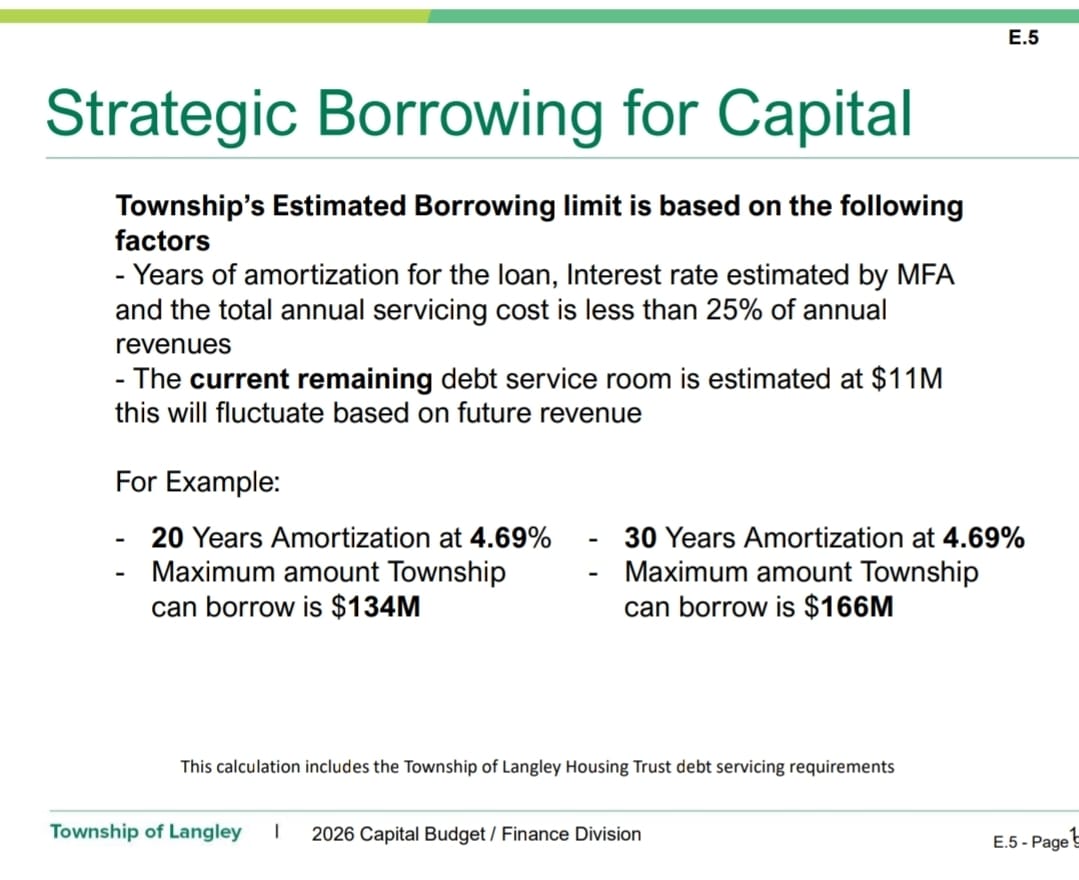
Both borrowing-room figures come from the Township, and the difference is mostly the Housing Trust. The February 2026 budget slide counts about $177 million of planned Housing Trust debt against the Township's borrowing limit and leaves about $11 million a year of room, enough for $134 million over 20 years or $166 million over 30. We reproduced that figure to the dollar. The $350 million the Township gave CBC only works if the Housing Trust is left out, or if a newer revenue year is used. Neither figure counts the $79 million the Township borrowed from its own reserves in 2026, which sits outside the limit entirely.
How fast the debt has grown
Debt fell slowly from 2020 to 2023 and then more than tripled in two years as the borrowing approved since 2023 was drawn: Fire Hall #5, strategic land purchases, the Ice and Dry Arenas, Smith Athletic Park, the Willowbrook Connector and 80 Avenue, Yorkson Community Park and other projects. In 2024 the Township's year-end debt was already the second-highest of any BC municipality, after Vancouver.
Every debt number you have heard, reconciled
Candidates and news stories have used many different totals. Most of them are correct for what they measure.
| Figure | What it counts | Source |
|---|---|---|
| $584.4M | All external debt actually owed at December 31, 2025, including temporary borrowing | 2025 audited financial statements, p. 38 |
| $420.3M | Long-term MFA debt in place, per the 2026 budget | 2026 Financial Plan, E.5 p. 96 |
| $602.7M | MFA debt in place plus new MFA debt in progress ($182.4M). This is the "$602 million authorized" CBC reported | E.5 p. 96; CBC, April 23, 2026 |
| $620.3M | The above plus the Willoughby Community Centre library ($17.6M), approved but not yet borrowed | E.5 p. 96 |
| $797.6M | The above plus the Housing Trust's planned $177.3M. This is the "almost $800 million" Langley Strong cites | 2026 Capital Budget, Housing Trust project sheet |
| $668M to $686M | Cumulative borrowing authorized by bylaw, including borrowing approved before 2022, as reported by staff in late 2024 and early 2025. Not all of it has been or will be drawn | Langley Advance Times, Dec 7, 2024; Langley Monitor, Feb 9, 2025 |
| $950M | A "projected debt limit" the Township gave CBC ($602M plus $350M). Not a number set by law | CBC, April 23, 2026 |
How the borrowing limit works
BC municipalities do not have a debt limit in dollars. Under section 174 of the Community Charter and the Municipal Liabilities Regulation, a municipality's annual cost of servicing its liabilities cannot exceed 25% of the previous year's "calculation revenue", which is property taxes, fees, grants in lieu and investment income, excluding DCCs and developer-contributed assets. Borrowing that Council has authorized but not yet drawn counts, and so do loan guarantees. The Inspector of Municipalities can approve going over.
"Room" in dollars therefore depends on assumptions: how much annual servicing room is left, the interest rate, and how long the loans run (30 years at most). The Municipal Finance Authority lends on a sinking-fund basis, so each dollar of room supports a little less principal than a simple mortgage would.
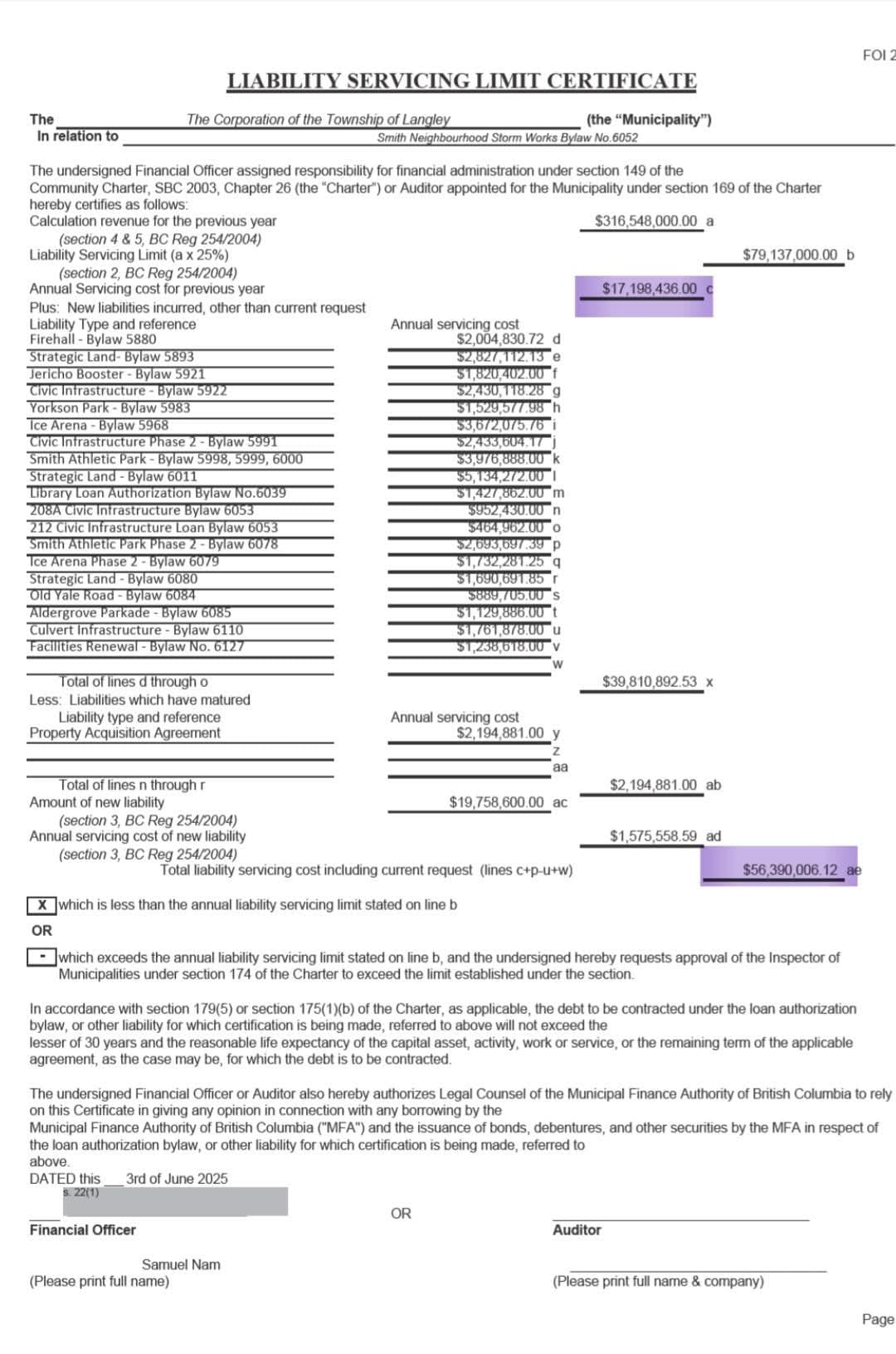
Rebuilding the budget slide's $11 million
| Calculation revenue on the June 2025 certificate | $316.5M |
| Liability servicing limit (25%) | $79.1M a year |
| Less servicing on all debt and approved borrowing bylaws | −$56.4M |
| Room before the Housing Trust | $22.7M a year |
| Less the Housing Trust's $177.3M, as 30-year MFA debt at 4.69% | −$11.7M |
| Room after the Housing Trust (the slide says "$11M") | $11.0M a year |
| Converted to principal at 4.69% | $134M (20 yr) / $166M (30 yr) |
Our reconstruction matches the slide to three decimal places using the MFA's sinking-fund method (4.69% interest, sinking fund earning 3.5%). By this measure the Township has used 86% of its limit.
So where does $350 million come from?
In an April 23, 2026 CBC story, the Township said it can take out another $350 million in debt, reaching a "projected debt limit" of $950 million, and that the budget slide showing $166 million was incorrect. CBC attributes these figures to the Township rather than quoting the Mayor directly. The Township has not published how it calculated them.
Changing the interest rate or term cannot get there. Even at 0% interest over the 30-year legal maximum, $11 million a year repays only $330 million. Reaching $350 million needs roughly $22 million to $29 million a year of room, which means counting different things. These are the three ways to get there:
| Scenario | Room a year | 20 years | 30 years | Our read |
|---|---|---|---|---|
| The budget slide | $11.0M | $134M | $166M | The Township's own February 2026 figure, with the Housing Trust counted. |
| A. Leave out the Housing Trust | $22.7M | $277M | $343M to $362M | Best fit. CBC's $602M also leaves the Trust out, and $602M plus about $350M gives the $950M "limit". |
| B. Use 2024 revenue instead of 2023 | $26.7M | $325M | $404M | Plausible. The certificate's $316.5M matches the Province's 2023 revenue figure; the 2024 figure is $379.5M. Unconfirmed. |
| C. Ignore borrowing already approved | $27.2M | $331M | $410M | Not legitimate. That $200M is approved and still has to be borrowed. |
It depends on whether the Housing Trust's debt is the Township's problem. The Trust is a separate society, consolidated in the Township's statements, that plans to borrow about $177 million to build roughly 250 rental homes with BC Housing. At the end of 2025 only $12.6 million of that was on the books, and the 2025 statements disclose no Township guarantee of its loans. Under the regulation it only counts against the Township's limit if the Township guarantees it or borrows on its behalf.
If taxpayers stand behind that debt, the slide's $166 million is the honest planning number. If they do not, the Township should say so, publish a current borrowing certificate, and explain why its own budget slide was wrong. Until then, residents are being asked to choose between two official figures that differ by $184 million.
What the limit does not count: $79 million borrowed from reserves
The Smith Athletic Park and the Ice and Dry Arenas still needed $95 million in 2026. Staff recommended taking $15.66 million from the CAC reserve and internally borrowing $79.05 million from three reserves, to be repaid from CACs and/or general revenue over up to 30 years at 4.69% (Report 26-14, recommendation (c)).
Section 189 of the Community Charter allows a municipality to lend money between its capital reserves, as long as it is paid back with interest by the time the lending reserve needs it. Because the Township owes the money to itself, it does not count against the provincial limit and does not appear in the $584.4 million. It is still debt. Repaying $79.05 million over 30 years at 4.69% costs about $5 million a year, or about $149 million in total. If sewer pipes need major work in the meantime, that money has to come from somewhere else.
The 2026 budget also covered $10.1 million of capital debt servicing as a one-time item from reserves. That coverage ends in 2027 and is a large part of the 22.80% tax increase projected for that year. See the financial sustainability page for how the 2026 tax increase was smoothed.
Borrowing bylaws behind the debt
| Bylaw | Purpose | Amount | Long-term borrowing |
|---|---|---|---|
| 5880 | Fire Hall #5 | $25.3M | April 2024, 4.44% |
| 5893 | Strategic land | $38.4M | September 2024, 3.83% |
| 5921 | Jericho booster station (water) | $18.7M | June 2025, 4.13% |
| 5922 | Willowbrook Connector and 208 Street | $29.5M | June 2025, 4.13% |
| 5938 | Yorkson Community Park | $14.6M | June 2025, 4.13% |
| 5968 | Ice and Dry Arenas | $49.5M | June 2025, 4.13% |
| 5991 | Willowbrook Connector phase 2 and 80 Avenue | $29.9M | June 2025, 4.13% |
| 5998, 5999, 6000 | Smith Athletic Park site, detention works and development | $59.6M | June 2025, 4.13% |
| 6052 | Smith neighbourhood storm works | $19.8M | October 2025, 3.73% |
| 6078 | Smith Athletic Park phase 2 | $39.3M | Temporary, converting |
| 6079 | Ice and Dry Arenas phase 2 | $25.3M | Temporary, converting |
| 6011, 6080 | Land purchases and strategic land | $72.9M | Temporary, converting |
| 6053, 6054 | 208A Street and 212 Street | $9.4M | Temporary, converting |
| 6084 | Old Yale Road | $7.0M | Planned spring 2026 |
| 6085 | Aldergrove parkade | $5.8M | Planned spring 2026 |
| 6110 | Culvert replacement | $12.8M | Temporary, converting |
| 6127 | Facilities renewal (roofs) | $9.9M | Temporary, converting |
| 6039 | Willoughby Community Centre library | $17.6M | Approved, not yet borrowed |
Amounts from the bylaws, the June 2025 certificate and the 2026 Financial Plan (E.5 pp. 96 to 98); rates from the 2025 Annual Report, Note 8 and Schedule 1. In 2026, $54.3M of temporary borrowing was converted to long-term MFA debt.
What residents should ask for
- Publish a current Liability Servicing Limit certificate every year, using the latest revenue, so residents can see the real room.
- Say whether the Township guarantees the Housing Trust's loans, and how the Province treats them.
- Explain the $350 million, or correct it.
- Publish the repayment schedule for the $79 million borrowed from reserves, and report each year on what has been paid back.
- Adopt a debt policy that keeps servicing well under the provincial ceiling, so there is room left for emergencies and for replacing aging infrastructure.
- Grow revenue without growing liabilities. Infill and multiplexes add tax base on existing streets and pipes. New greenfield infrastructure adds maintenance costs for decades.
Sources
- Township of Langley 2025 Annual Report, Financial Section (pp. 32, 38, 41, 50 to 52, 56, 58, 70 to 71, 77)
- February 23, 2026 Council agenda, Report 26-14, Draft 2026 to 2030 Financial Plan (E.5 pp. 1, 6, 28, 93, 96 to 98)
- 2026 Budget Slides and Capital Budget
- CBC News, "Why Langley Township's $600M debt is city hall's biggest debate," April 23, 2026
- Province of BC Local Government Statistics, Schedules 601.1, 602.1 and 603 (2018 to 2024)
- Community Charter, Part 6 (ss. 174, 179 to 182, 189) and Municipal Liabilities Regulation, BC Reg 254/2004
- June 3, 2025 Liability Servicing Limit Certificate, obtained through a freedom of information request
Calculations are ours and are shown above. Strong Towns Langley is a non-partisan community group and does not endorse any slate. Related: Financial Sustainability · Are CACs legal in BC?